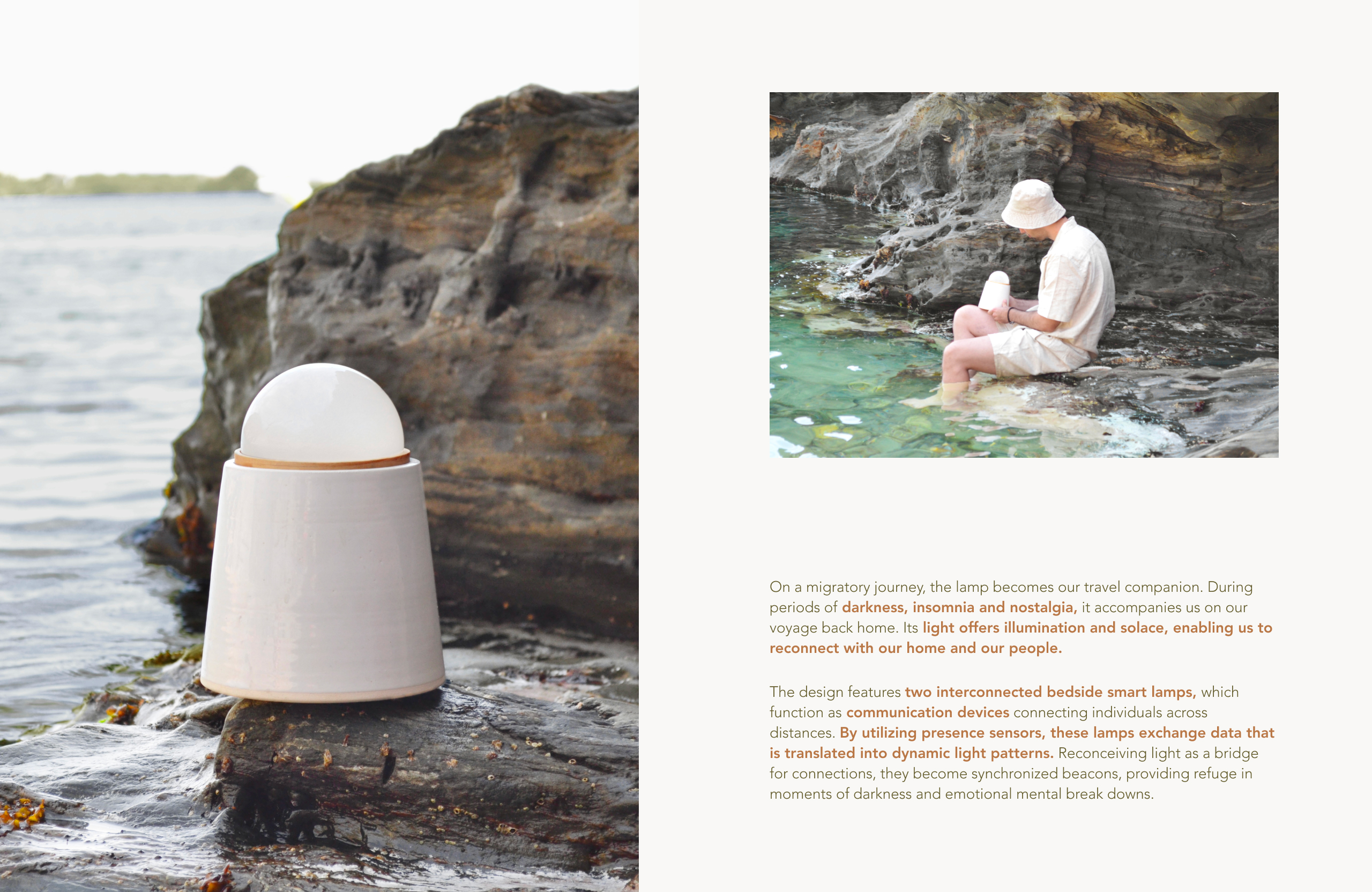
International mobility has generated emotional challenges such as loneliness stemming from homesickness and FOMO. CREUS redefines conventional domestic lighting by serving as an active element in the communication between individuals who are geographically separated.
From an ethnographic issue to universality, CREUS was born out of the need to connect with those who are far away. In the quest for products that could create a sense of home, even thousands of kilometers away, the question arose: What makes a home? As an ecosystem of tranquility and security, home is defined by mere presence, indirect interaction, and non-verbal communication. We focused on the most organic interactions and everyday life of a home, to create light points of reference, connection, and communication.
Two interconnected bedside smart lamps, though geographically separated. Based on inputs of presence, motion, and distance, the lamps exchange values to convert them into dynamic light patterns. Lamp A processes these sensor inputs and sends the data as outputs to Lamp B. Lamp B then translates these outputs into light, and vice versa. That is to say, the Creus Faro will light up when the Creus Mare Nostrum detects presence, and its brightness will adjust based on the detected distance of the individual. Both lamps feature microcontrollers with integrated Wi-Fi and microwave distance sensors, as well as programmable RGB LEDs.
Social media and messaging platforms, despite offering a sense of connection, paradoxically tend to exacerbate feelings of loneliness due to the pervasive influence of FOMO. CREUS addresses homesickness through light comfort. Aiming to foster new forms of connection and well-being, it uses light as a bridge of communication during moments of insomnia and nostalgia. By introducing interactions based on Quiet Moments Together, CREUS emphasizes the most organic interactions and daily routines of home life.